



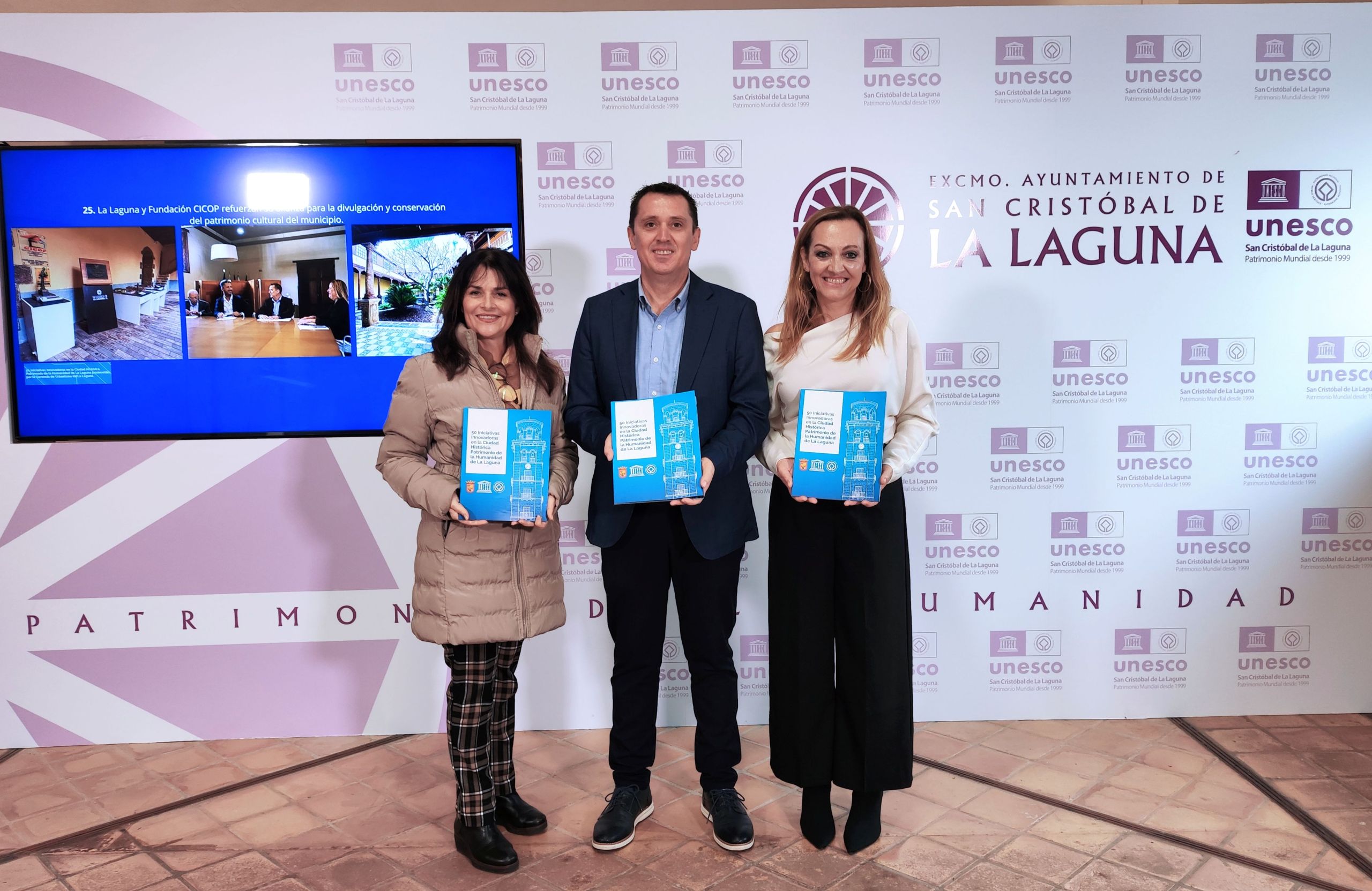
La Laguna today presented the ‘Manual of 50 Innovative Initiatives in the Historic World Heritage City’, a document that consolidates the municipality’s regional leadership in heritage management and reaffirms it as a laboratory of good practices that can be replicated by other heritage cities. The publication, promoted by the Municipal Urban Planning Department, organises and highlights the most exemplary actions carried out in recent years, becoming a management, communication and reputation tool that seeks to reinforce La Laguna’s profile in terms of awareness, accessibility, sustainability and innovation.
The Councillor for Cultural Heritage and Land Use Planning, Adolfo Cordobés, and the accessibility and sustainability consultant Noemí Delgado, head of the drafting team, presented the details of this document, which highlights the joint work of technicians, public officials and citizens, and reaffirms La Laguna’s desire to remain an open, lively, inclusive and constantly evolving heritage city.
Adolfo Cordobés pointed out that the manual is “much more than a testimony to what it means to be a World Heritage City. It shows that La Laguna does not merely preserve its heritage, but lives and shares it, positioning the city as an example of innovation and good practices that can be replicated in other heritage cities, strengthening alliances with UNESCO, ICOMOS, CICOP and the Group of World Heritage Cities of Spain”.
‘This document,’ he explained, ‘is a technical analysis tool that allows us to recognise and assimilate the enormous work that has been done in La Laguna in terms of heritage management, but from an orderly and verifiable perspective that reflects how, behind each project, there is planning, evaluation and measurable results.’
In addition, Cordobés praised the fact that the initiatives included are in line with the Sustainable Development Goals, from sustainable mobility and tactical urban planning to emissions reduction and universal accessibility. ‘Heritage is only universal if it can be experienced and understood by everyone,’ he said, recalling the European awards that endorse La Laguna’s inclusive model.
The councillor, who is also the director of La Laguna’s Urban Planning Department, highlighted the involvement of residents, groups and institutions in the development of the city, which is reflected in a manual that ‘not only documents what has been done, but also projects what is to come.’
In this regard, she recalled that ‘we have created pioneering structures, such as the Office for the Comprehensive Management of the Historic Centre; we are extending protection to hundreds of buildings and will very soon begin drafting the Historic City Management Plan, which will enable us to plan coherently and with a view to the future’.
Objective impact criteria
Consultant Noemí Delgado, head of the drafting team, explained the process of preparing this document, which not only compiles actions but also contextualises and measures them in terms of results.
‘We started with a thorough analysis of files, plans and projects developed by the local administration, to which we added interviews with technical teams, consultations with experts and contributions from organisations. In addition, each initiative was evaluated using objective criteria of social impact, sustainability, replicability, innovation and contribution to the Outstanding Universal Value of La Laguna,’ she explained.
“The value of this work is that it allows seemingly disparate actions to be viewed within a common frame of reference. By linking each initiative to the Sustainable Development Goals, the manual provides a universal language that facilitates comparison, funding and replication in other heritage cities. It is, in short, a technical tool that demonstrates how La Laguna has successfully integrated conservation, accessibility, innovation and citizen participation into a coherent strategy,” added Delgado.
The manual is structured into thematic sections covering governance, heritage conservation, rehabilitation projects, coordinated work with the World Heritage Cities Group, institutional partnerships, training, awareness-raising, innovation and notable events.
The initiatives included are the creation of the Office for the Comprehensive Management of the Historic Centre, the first Management Plan, the rehabilitation of emblematic spaces, the protection of intangible heritage, and educational and innovative projects.
The publication is conceived as a letter of introduction to La Laguna to the world, consolidating its leadership in accessibility and sustainability, reinforcing its candidacy for European grants and programmes, and projecting its image as a lively city committed to its history and its citizens.