



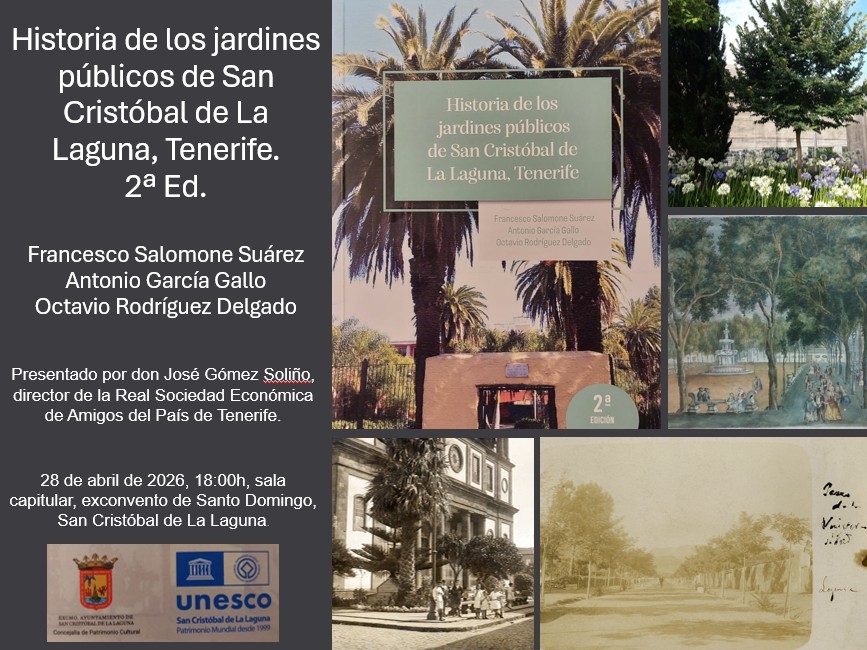
The work of Francesco Salomone, Antonio García Gallo and Octavio Rodríguez Delgado analyzes five centuries of evolution of the urban landscape and its biodiversity
The Chapter Room of the former Santo Domingo Convent in La Laguna will host, on April 28, the presentation of the second expanded edition, translated into English, of the book “History of the Public Gardens of San Cristóbal de La Laguna.” This work is by Dr. Francesco Salomone Suárez, an agricultural engineer and technical director of the City Council’s Parks and Gardens Unit, and Dr. Antonio García Gallo and Dr. Octavio Rodríguez Delgado, both retired professors in biology from the Department of Botany, Ecology, and Plant Physiology at the University of La Laguna.
This new revised edition expands the content, incorporates updated documentation, and offers a complete English version of a work that has become a key reference study on the evolution of La Laguna’s public gardens from the conquest of the island to the present day. This will allow for the dissemination of knowledge about La Laguna’s green heritage beyond the local and regional spheres.
In fact, the book analyzes more than five centuries of history through the municipality’s landscaped spaces, from the earliest tree-lined avenues and historic promenades to contemporary parks, and documents the extraordinary plant diversity that characterizes La Laguna.
The municipality currently boasts 733 landscaped areas, more than 550 ornamental species from around the world, and 63 endemic species, making its gardens a first-rate botanical, cultural, and educational resource. The work also delves into the social role of these spaces, which have served as meeting places, cultural hubs, and centers of community life for generations.
The presentation, with free admission until capacity is reached, will begin at 6:00 p.m. and will feature the participation of the Councilor for Cultural Heritage, Adolfo Cordobés, and the President of the Royal Economic Society of Friends of the Country of Tenerife, José Gómez Soliño, along with the authors of the book.
Adolfo Cordobés emphasizes the importance of this publication for understanding this heritage value, stating that “it reminds us that historic gardens are not simply green spaces, but an essential part of La Laguna’s urban memory. Biodiversity, history, and the city’s identity are intertwined within them, and their study and conservation are fundamental to understanding who we are and how we have evolved over more than five centuries.”
The councilor also highlights the support of the Cultural Heritage Department for this work, “a research project that provides a solid foundation for continuing to advance the responsible and sustainable management of natural heritage, which is inseparable from cultural heritage in a World Heritage City.”
For his part, author Francesco Salomone explains that this expanded edition “is the result of many years of fieldwork, documentary research, and botanical analysis, and aims to bring the richness and complexity of La Laguna’s gardens closer to the public.”
Witnesses to local history
Salomone adds that “the public gardens of La Laguna are authentic witnesses to the city’s history. Every species, every row of plants, and every landscaped space tells a part of the urban narrative, and we believe this work contributes to highlighting a heritage that, although sometimes overlooked, forms an essential part of La Laguna’s identity.”
With this new edition, “History of the Public Gardens of San Cristóbal de La Laguna” is consolidated as a fundamental tool for the research, dissemination, and management of the municipality’s green heritage, reinforcing the vision of La Laguna as a city that recognizes its gardens and biodiversity as a central element of its cultural identity.
The presentation on April 28 will offer an accessible introduction to the book’s content, which combines historical, botanical, and urban planning analysis with a focus suitable for all audiences. The work is aimed at specialists in heritage, botany, or urban planning, as well as anyone interested in learning more about the city and its evolution.
Furthermore, it is worth noting that the Urban Planning Department of La Laguna continues to make progress in processing the Special Autonomous Development Plan and the Municipal Catalogue for the Protection of Singular Trees and Groves, an instrument that has already received a favorable environmental report and is currently undergoing initial approval. In total, the plan regulates more than 70 hectares distributed throughout the municipality, excluding the Anaga Rural Park and the Historic District, which have their own management plans.
The future approval of this catalogue will reinforce La Laguna’s vision as a municipality that recognizes its green heritage as an essential component of its cultural, landscape, and environmental identity. Its development complements and expands the understanding of the value of gardens, trees, and groves in shaping the urban landscape and the collective memory of the municipality, fully consistent with research such as that presented in this book.